
When a client cancels at the last minute, you're left with an empty chair, a wasted hour, and revenue that walks out the door with them. Two tools get thrown around as the fix, and owners keep asking which one actually earns its keep. This post breaks down deposits vs waitlist head to head, so you can decide where to put your energy when a spot suddenly opens up.
The short answer is that they solve different halves of the same problem. Deposits change how people behave before an appointment. A waitlist rescues the slot the moment someone cancels. In the deposits vs waitlist debate, the honest takeaway is that they're teammates, not rivals, so let's look at what each one really does when a client bails.
Deposits vs waitlist: what each one actually does
A deposit asks the client to put money down when they book. It's a commitment device, and for high-value services like color corrections, injectables, or long grooming sessions, that upfront skin in the game can nudge people to show up or cancel earlier instead of ghosting you. Deposits, clear policies, and a solid reminder habit are all tactics you can use to cut down on flaky bookings.
But here's the part owners forget: a deposit softens the sting of a lost booking, but it does nothing to fill the empty slot. You keep the fee and still stare at a hole in your day. And deposits do nothing for the last-minute cancellation that's technically "allowed" under your policy. If a client cancels the morning of and you wave them off, you're right back to an open appointment with no one to take it.
That gap is exactly where a waitlist earns its keep. A waitlist doesn't try to change the client's behavior at all. It races to replace them the instant a spot frees up, turning a dead hour back into a booked one before the day slips away from you.
How a waitlist fills the last-minute cancellation
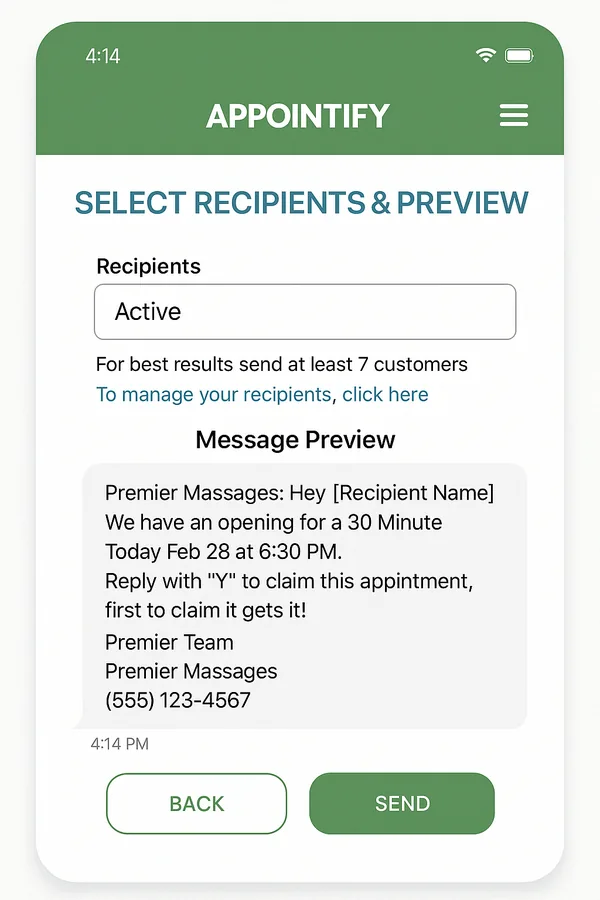
The instant a client cancels and frees an appointment, the right people on your waitlist get a text, and the first one to reply books the open slot. You go from an empty hour to a paying client, often in minutes, with zero phone tag and no scrambling through your contacts. This is the piece a deposit simply can't touch: a deposit protects the money on one booking, while a waitlist protects the calendar itself.
Appointify is a free waitlist app built for exactly this moment. You keep your current booking software and run the waitlist alongside it. When someone cancels, you tap once, the app instantly texts your in-app waitlist, and whoever replies first books the slot. You can see how Appointify fills last-minute cancellations without changing the tools you already rely on every day.
One thing to be clear about: Appointify fills cancellations, it does not stop no-shows. A true no-show gives you zero warning, so there's nothing to hand off and no time to text anyone. If someone simply never turns up, that's a job for your own reminders, confirmations, deposits, and a clear cancellation policy. Appointify's job starts the moment a slot actually opens, and on that job it's fast.
When each approach fits best
- Reach for deposits on long, expensive, or high-demand services where clients are prone to flaking and you can enforce a clear policy.
- Reach for a waitlist whenever a cancellation opens a slot and you need to fill it fast, which is most of the time.
- Reach for both when you want steadier bookings up front and a safety net that recovers the cancellations that slip through anyway.
Why most owners should start with the waitlist
If you can only set up one system this month, start with the waitlist. It's simpler, there's no card to collect, and it directly recovers revenue from cancellations instead of just discounting the loss. Deposits take a policy decision, a payment processor, and an awkward conversation with clients. A waitlist takes a few minutes to set up and starts working on your very next cancellation.
There's also no cost barrier. Appointify is free, needs no credit card, and charges nothing per booking, so you're not trading one revenue leak for a new monthly bill. It sets up in a few minutes and runs quietly next to your existing scheduler. For higher-ticket work like injectables and facials, a waitlist pairs especially well with a light deposit, which is why so many practices reach for a waitlist app for med spas alongside their booking flow.
A quick note on expectations: Appointify is not a full scheduler and it's not a payment processor, so it won't collect deposits for you. It does one job extremely well, which is filling the openings your calendar creates when clients cancel. If you have questions about how it fits with your current setup, the Appointify FAQ walks through the common ones.
The bottom line on deposits vs waitlist
Deposits and waitlists aren't competitors, they're a pair. Deposits and good policies are your own tactics to steady the front end of your calendar. A waitlist makes sure that when a client cancels anyway, the slot doesn't stay empty. If you want the fastest win with the least friction, put a smart waitlist in place first, then layer deposits onto your highest-value services once you're ready.